
MEDIATORS BETWEEN
HUMANS AND SPIRITS
BY SYLVIA FURRER & HOLGER HOFFMANN
“To me, spirits are something truly real. The world is full of them.” So says the Tuvan writer Galsan Tschinag, who is himself a shaman. Through his books “The Blue Sky” and “The Gray Earth,” as well as reading Yuri Rytkheu’s novel “The Chukchi Bible”, I gained my first insight into Siberian shamanism.
After eight trips to Siberia, during which we mostly traveled with nomads in the winter, we found ourselves in the Republic of Tuva, bordering Mongolia. We have already been exploring the Altai Mountains for ten days when, one morning, we spot a group of people on a hill not far from the Yenisei River. Curious as we are, we persuade Mikhail, our guide, to climb the hill.
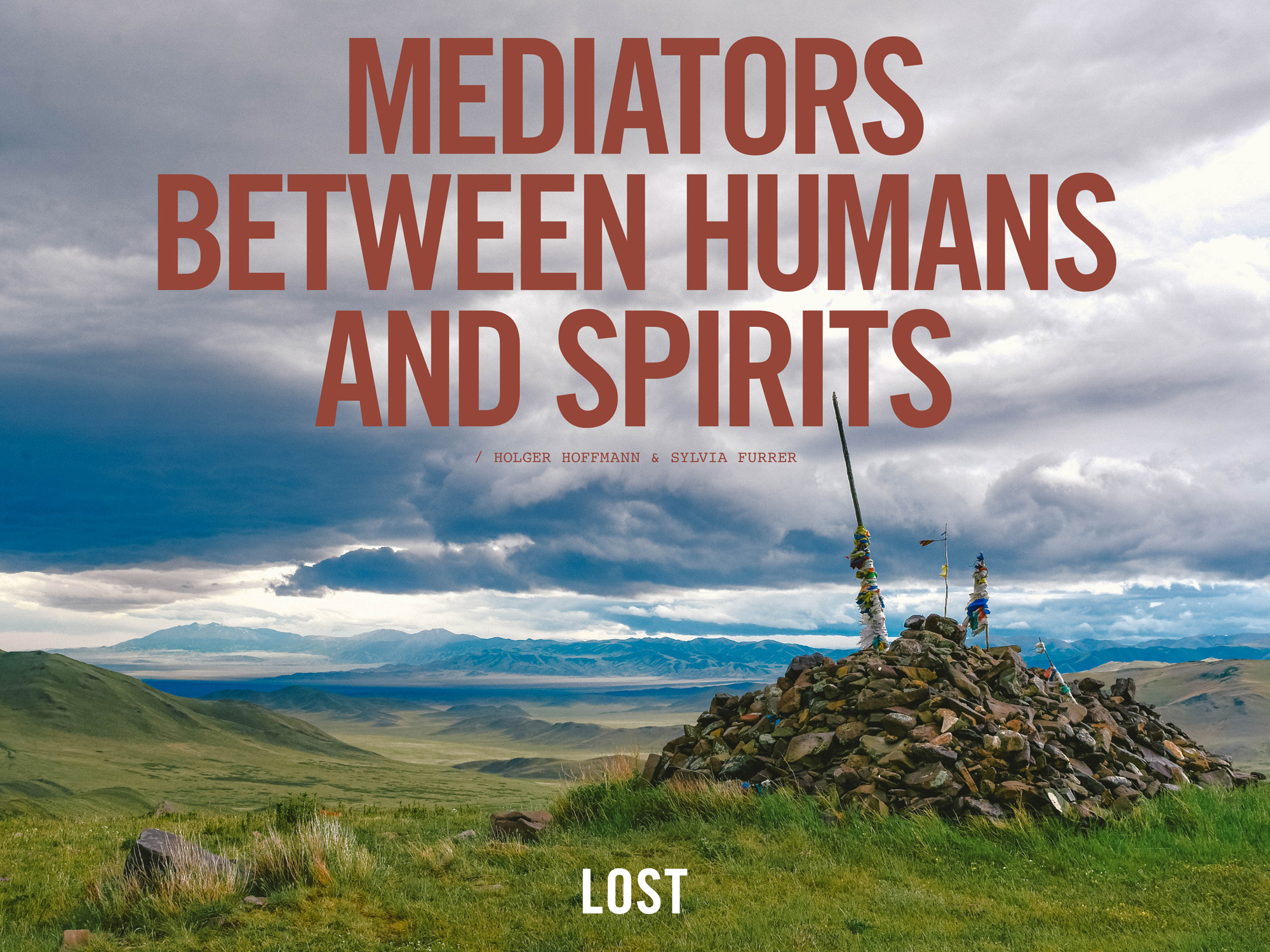
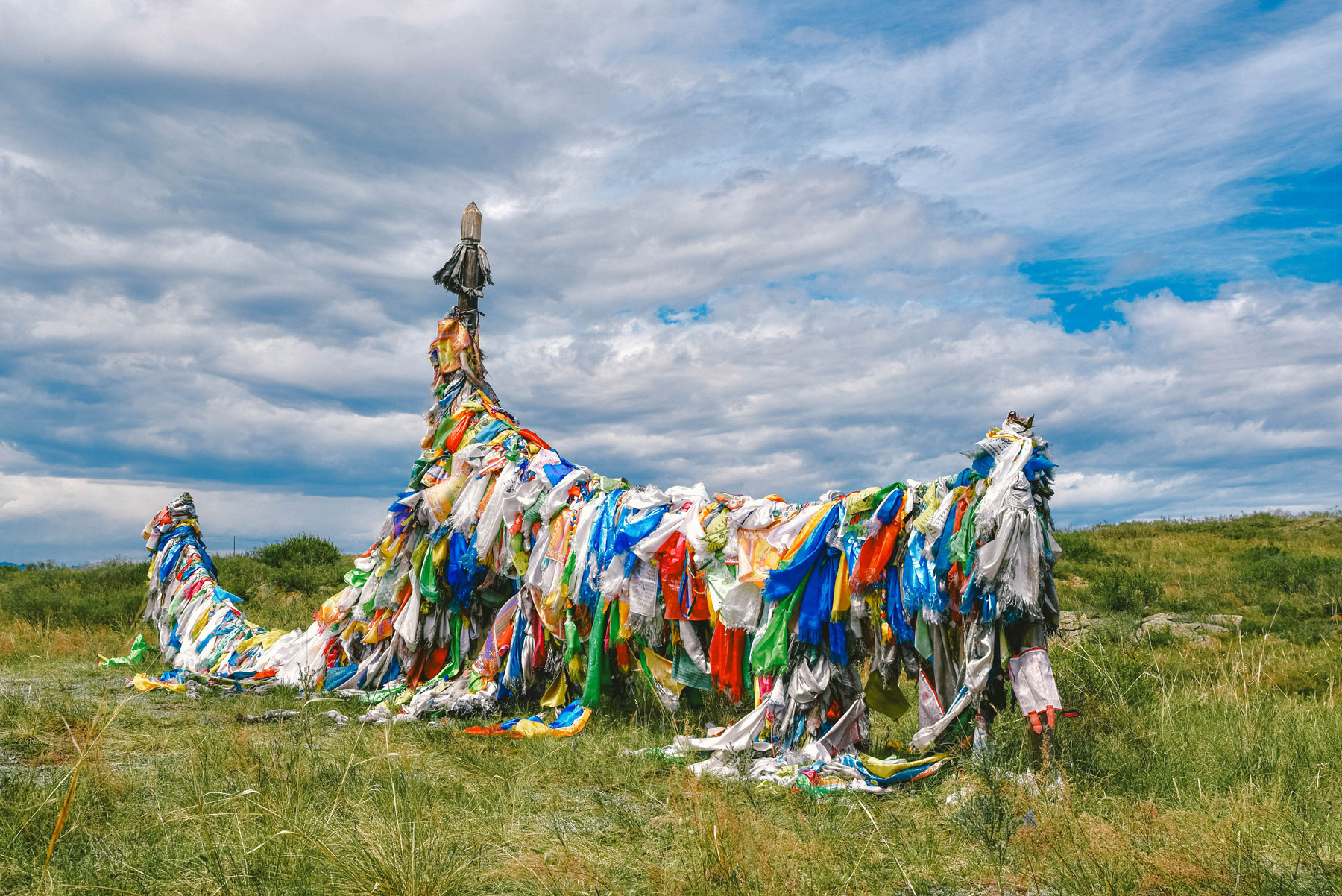
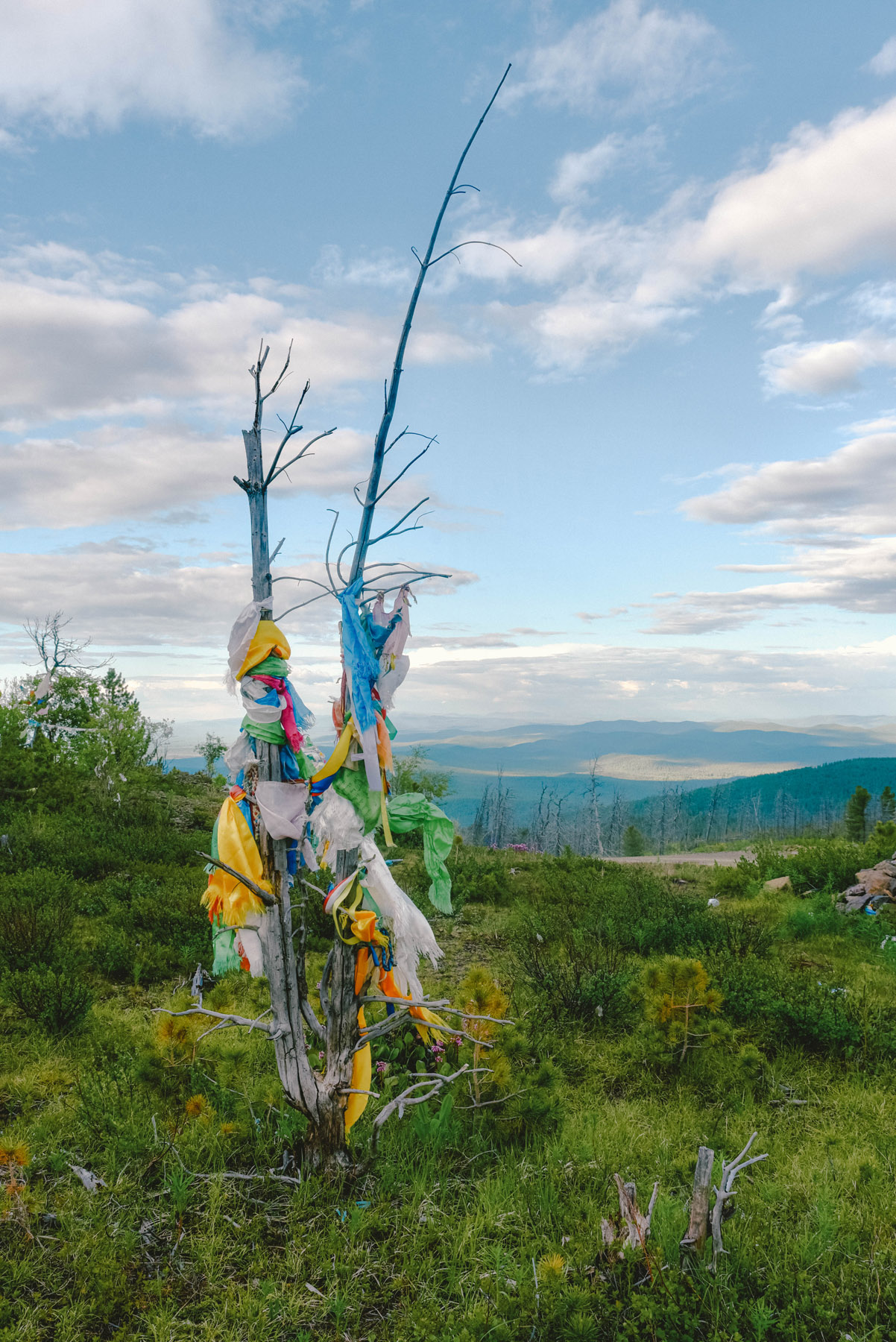
Before us stretches a vast expanse of silence, as if someone had turned down the volume. Only the wind remains. It sweeps across the grass of the hill and tugs at the colourful cloth ribbons (khadags) tied to the ovoo—a pile of stones with wooden poles stuck in them, bearing countless khadags left behind at this sacred site over the years.
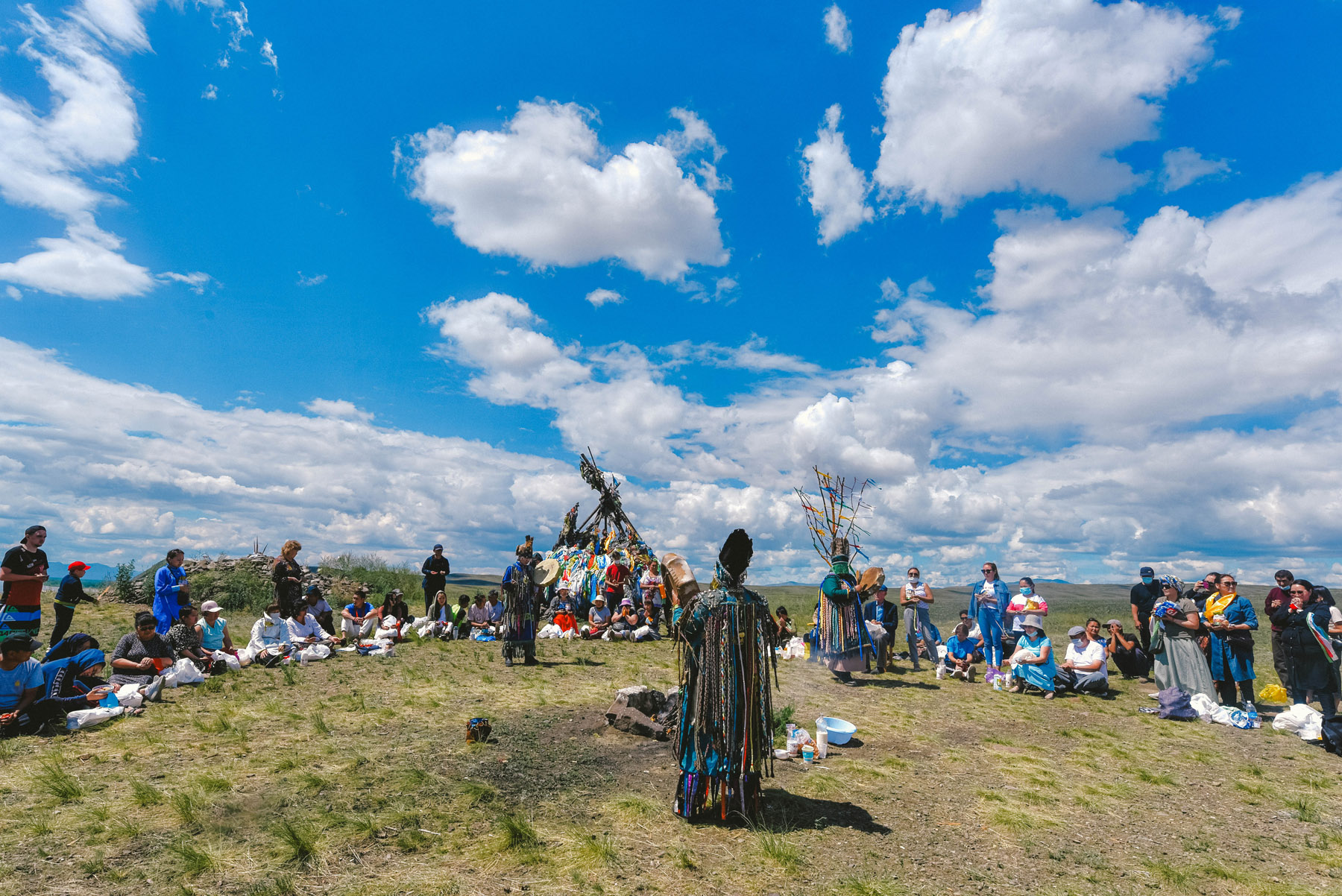
Over fifty people sit expectantly in a wide circle, at the top of which the ovoo stands. No one pushes, no one speaks loudly. It seems as though the place itself is setting the pace. We are lucky; the ceremony seems to have just begun. “Here,” Michail says quietly, almost more respectfully than usual, pointing to the ovoo. “This is the place of the ancestral spirits.” Holger pauses for a moment, raises his camera, then lowers it again. “I first need to understand what’s happening here,” he mutters. I nod. Me too.
Michail asks an elderly man for details and explains to us: “This is a Tailgan ceremony.” Those present are members of a clan and have travelled by bus to this sacred hill to invoke their ancestors through shamans and ask them, with symbolic offerings, for the protection of the community, fertility and prosperity.
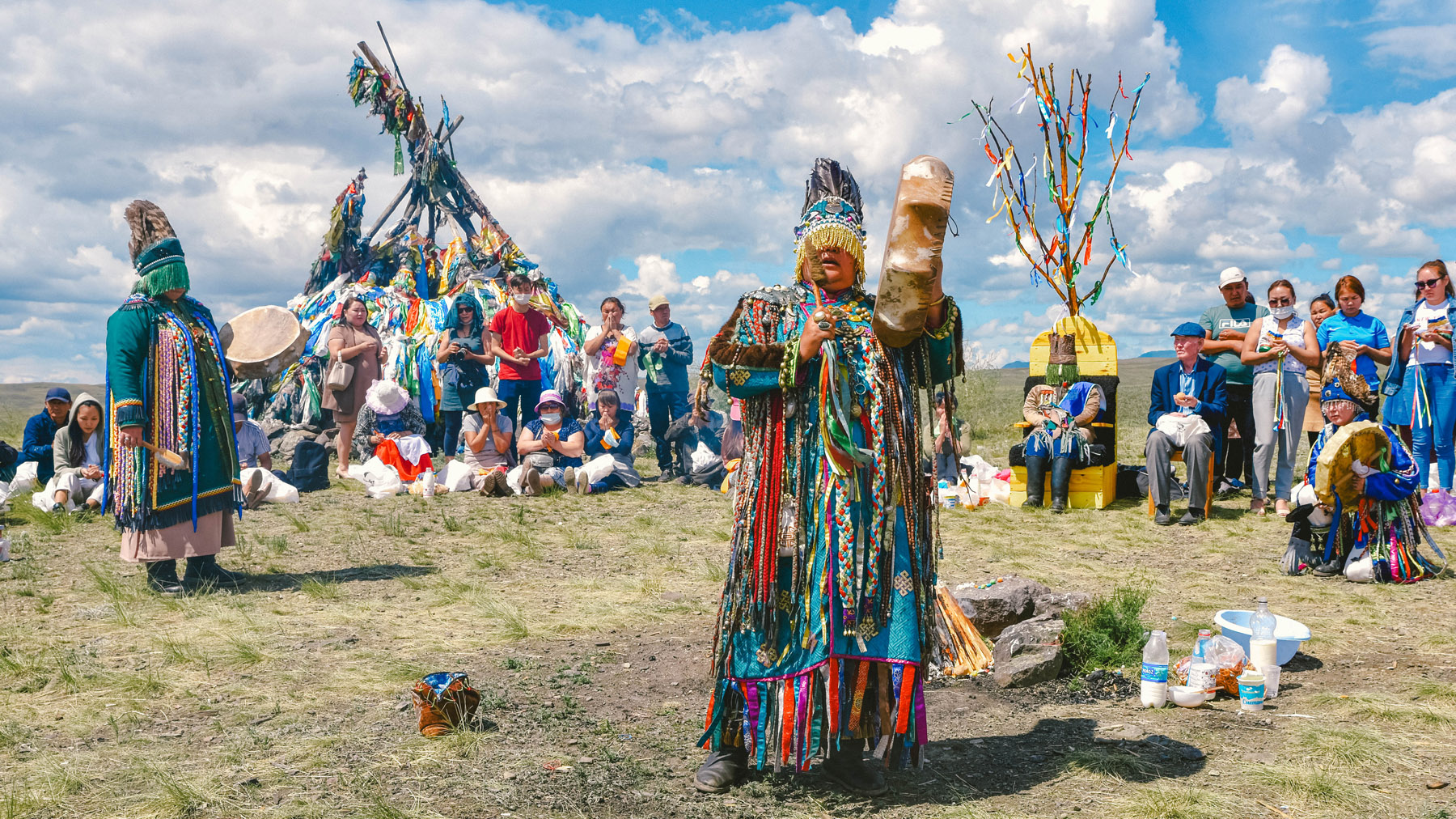
We stop at the edge of the circle. Although we are the only foreigners, we do not attract much attention and are welcomed tacitly. My gaze wanders around. Right next to the ovoo, a life-size cloth doll sits enthroned on a wooden chair, wearing a shaman’s cap. Behind it rises a gnarled tree, adorned with colourful khadags fluttering in the wind. “That is the World Tree,” explains Mikhail, “it symbolises the axis of the world, which leads the way back to the very beginning of creation.”
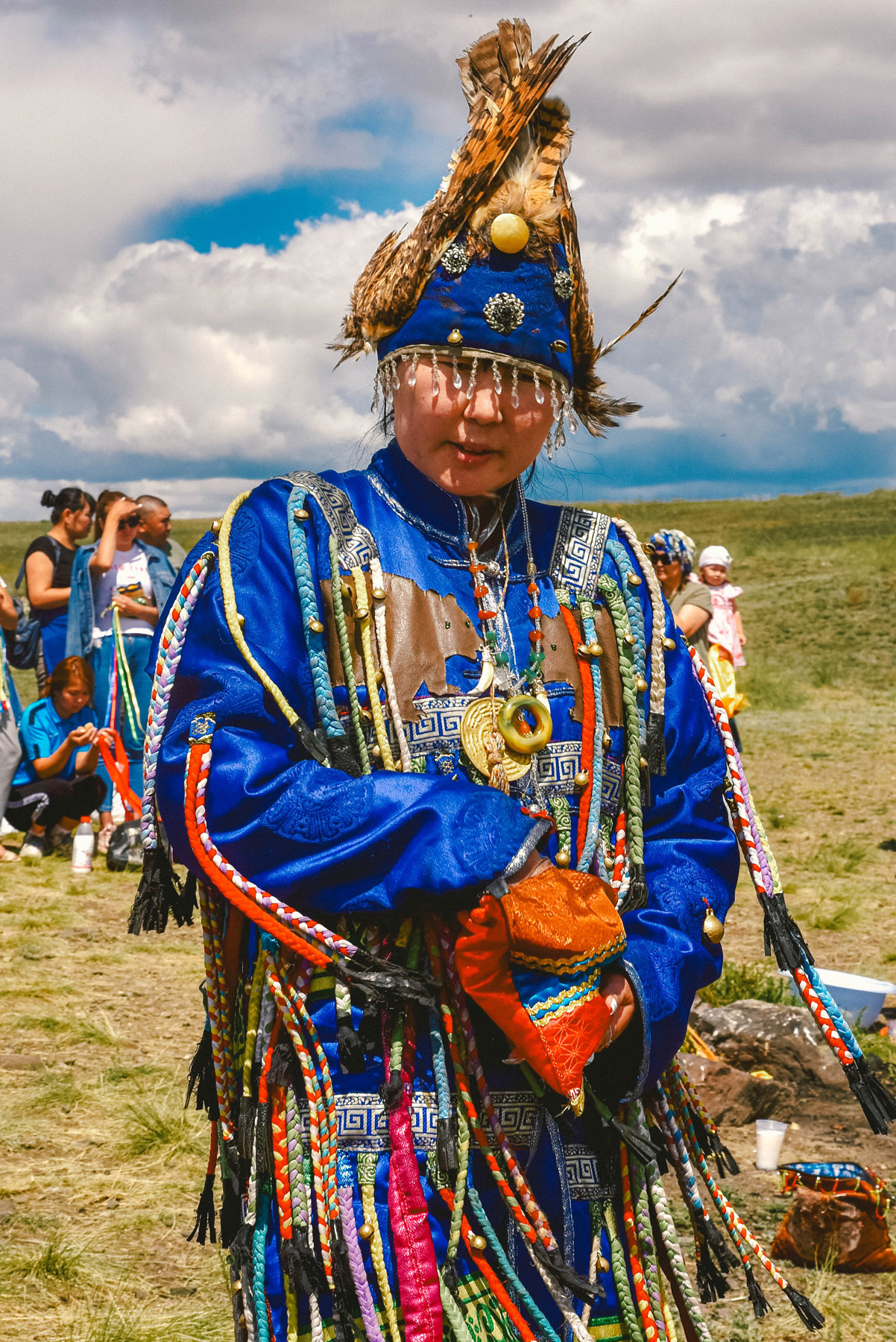
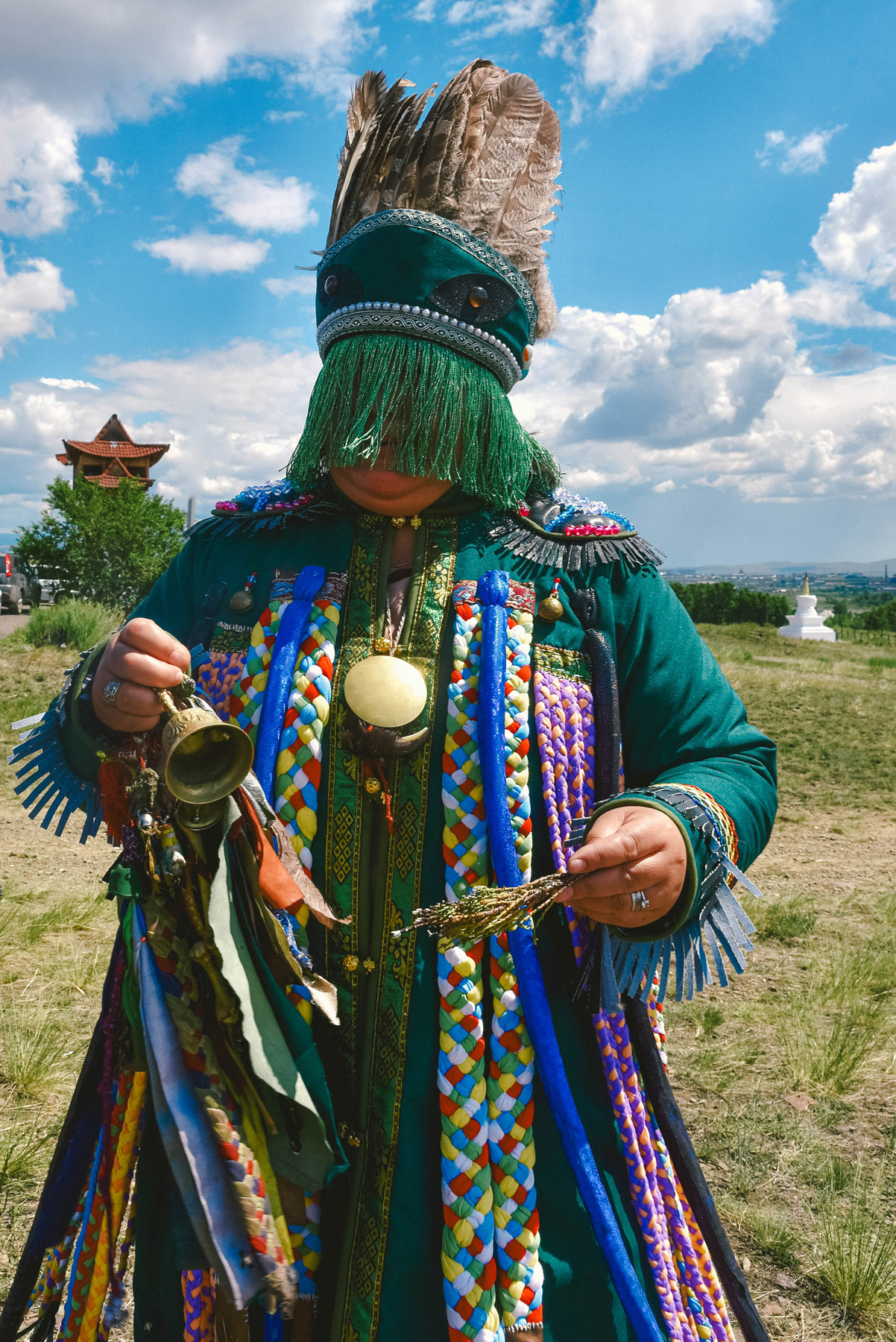
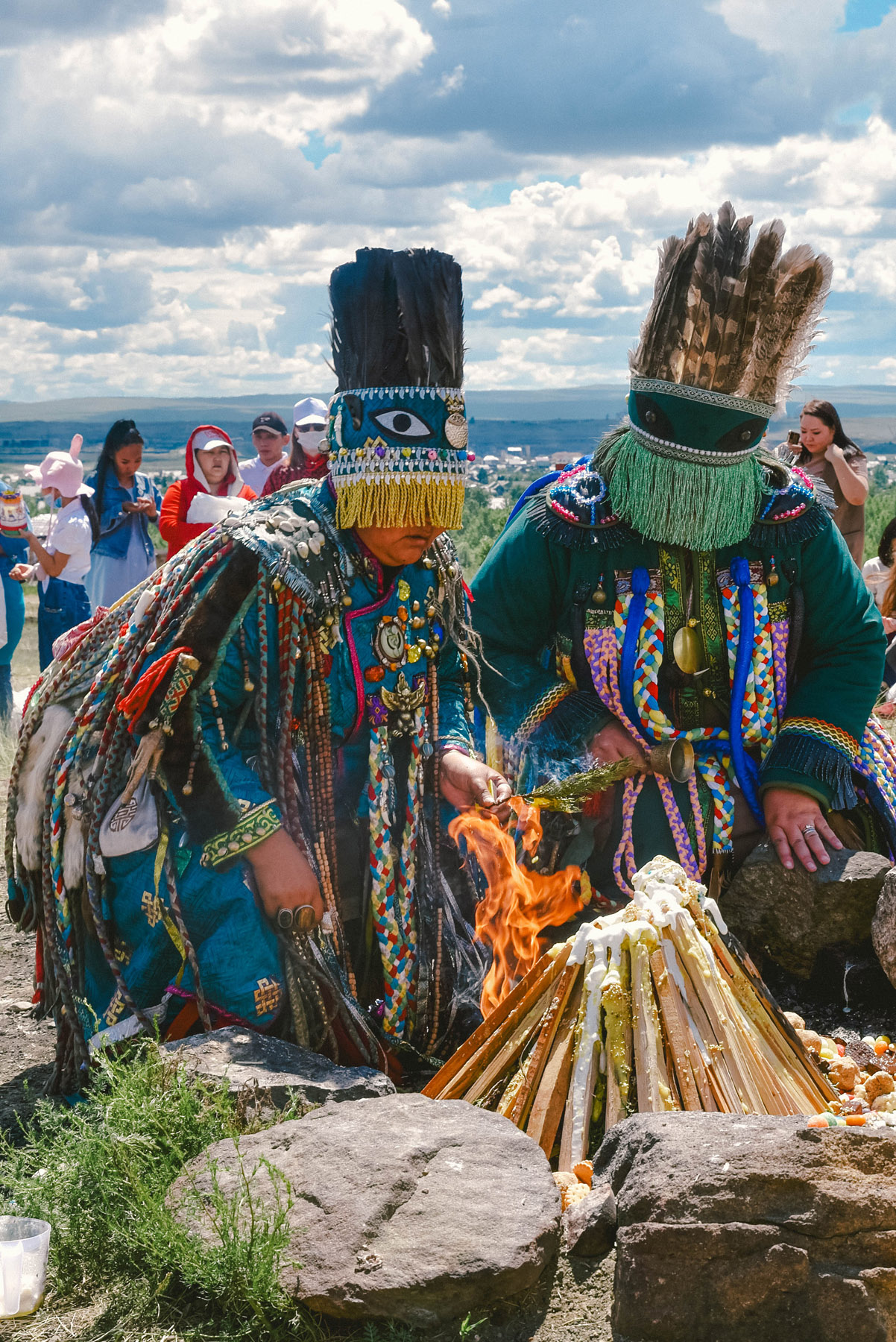
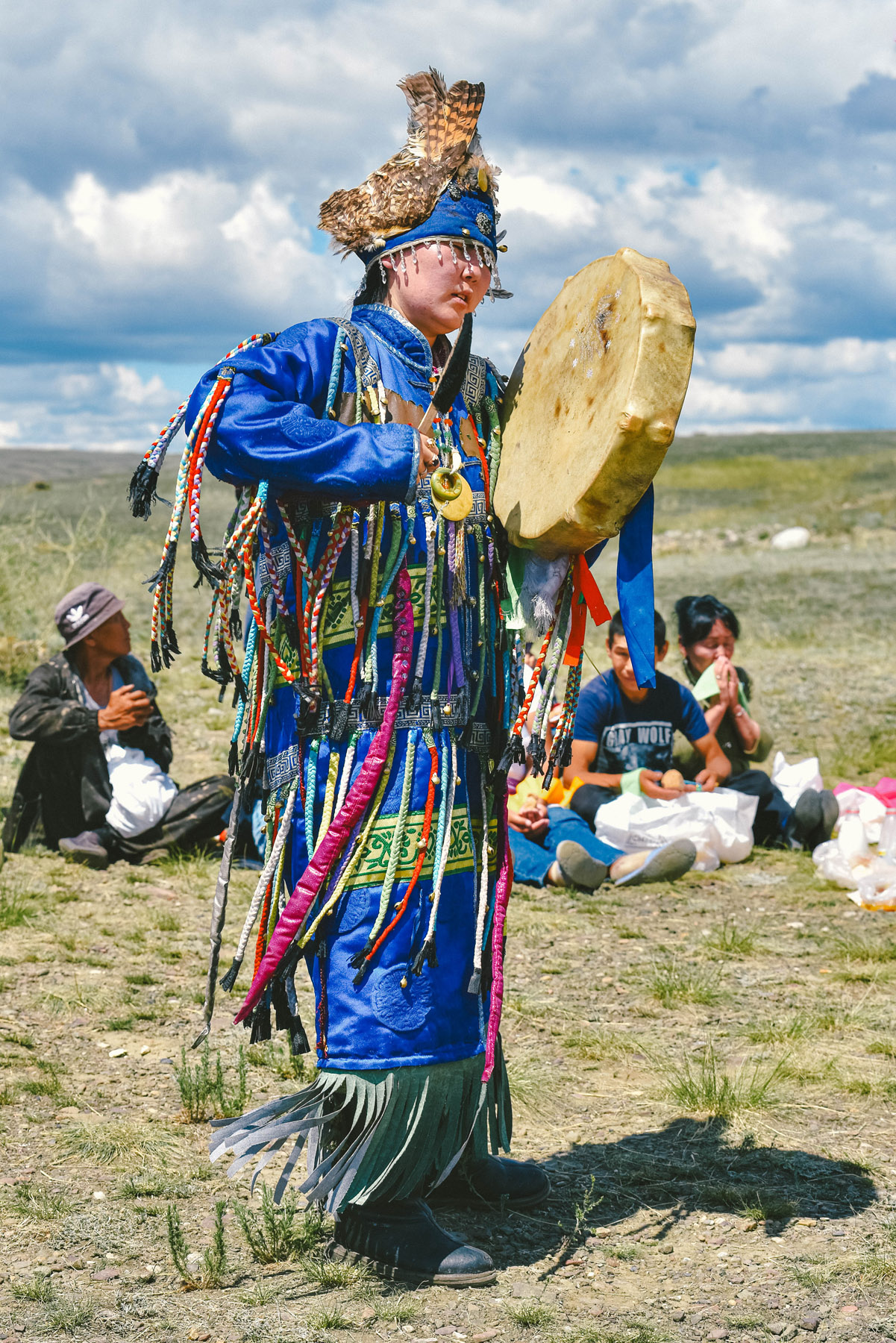
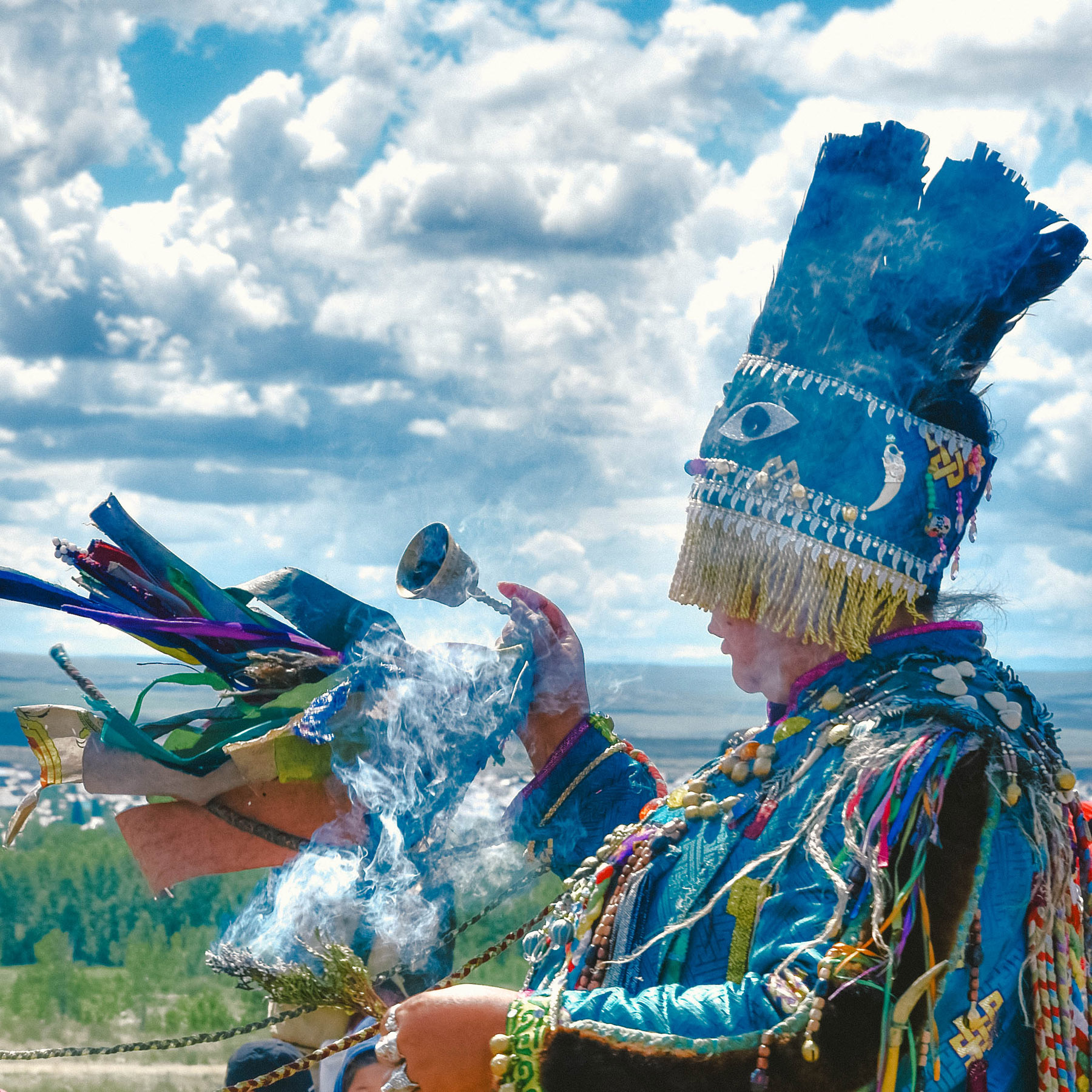
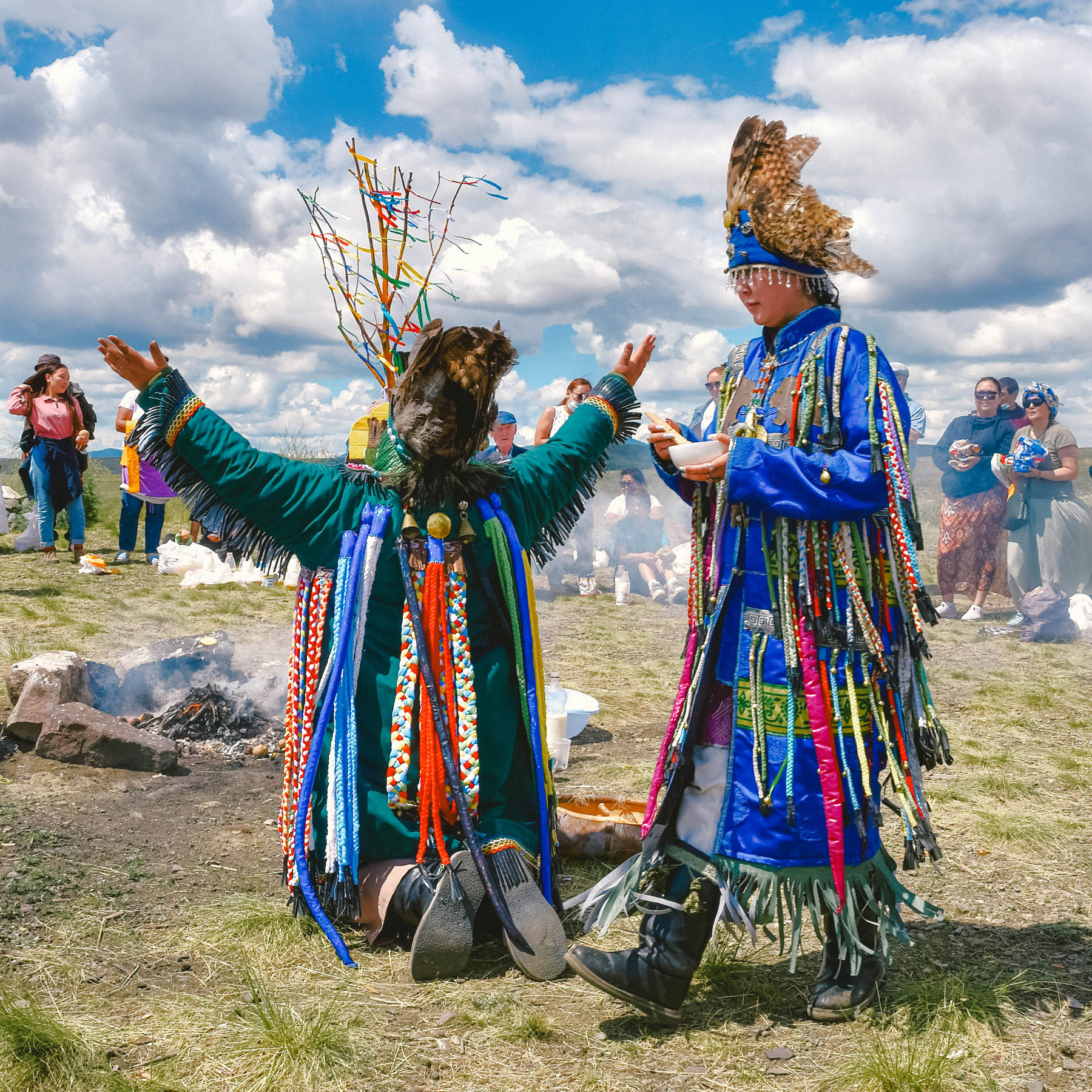
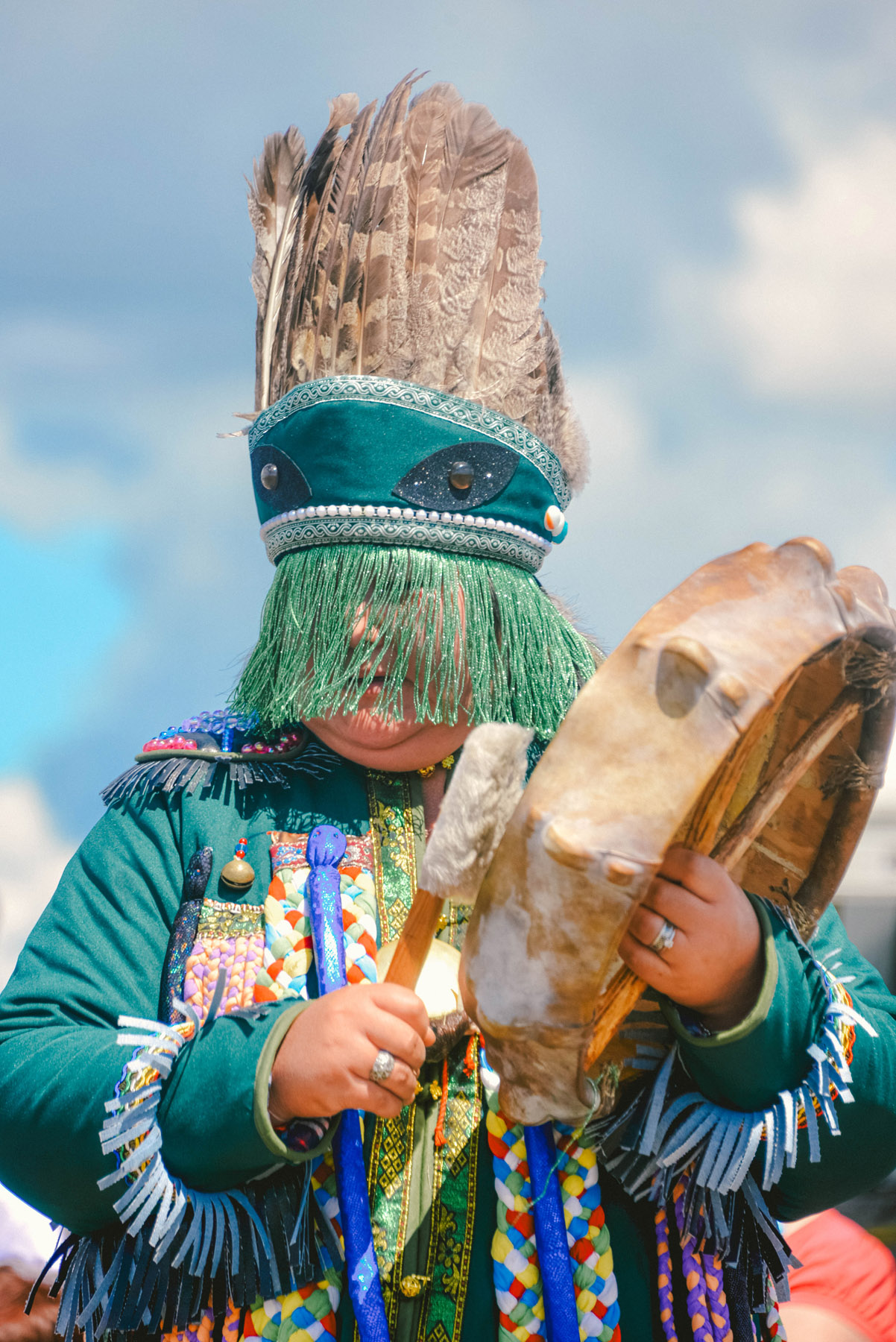
The women spread out cloths upon which they place food, sweets and small offerings. Children sit close to their parents, quieter than one might expect. In the centre I see three female shamans. Their robes shimmer in shades of blue, green and turquoise, interwoven with braided coloured ribbons and metal amulets that clink softly with every movement. Their heads are covered by shaman’s hats adorned with eagle feathers, the fringes of which conceal their faces.
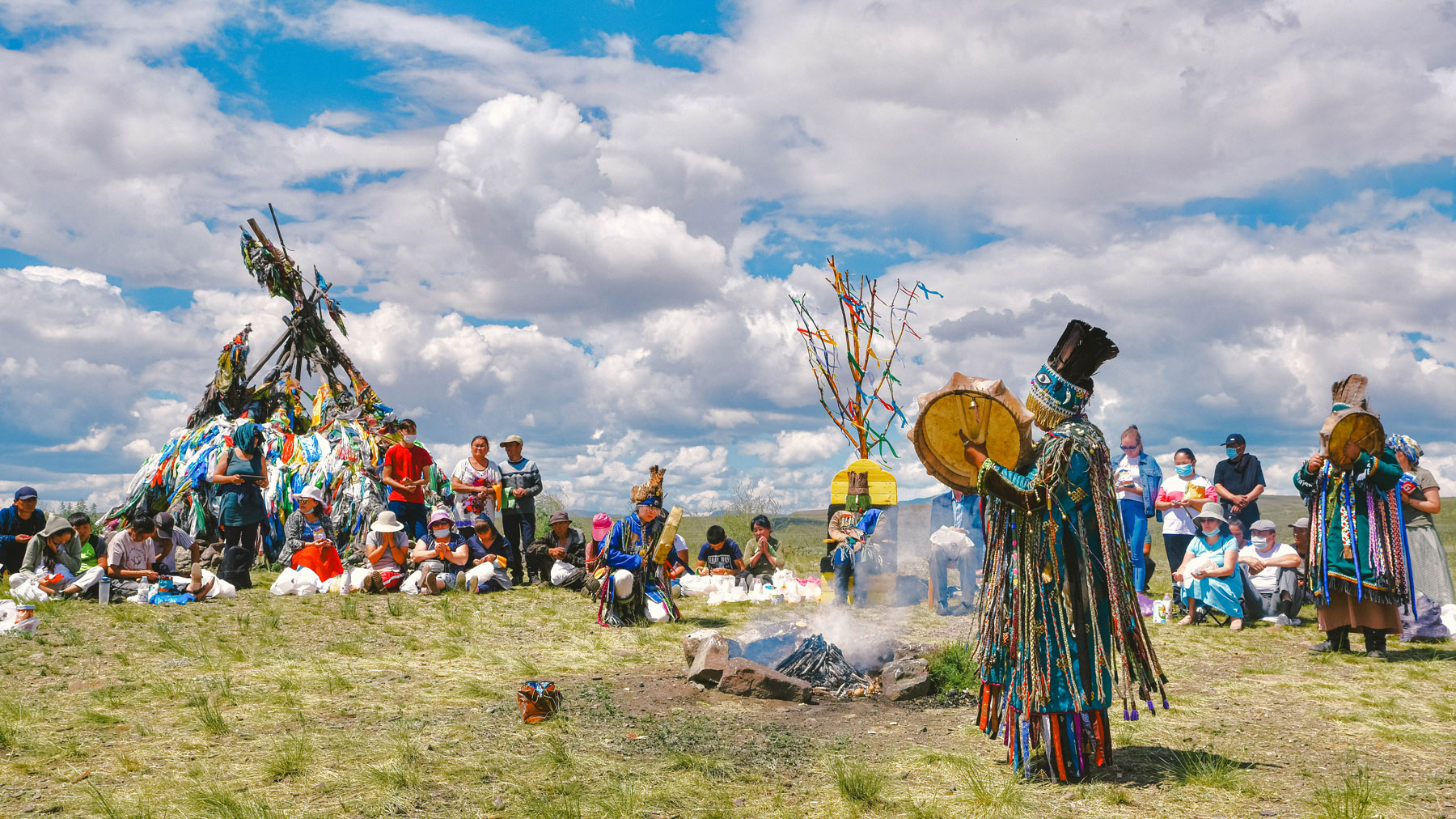
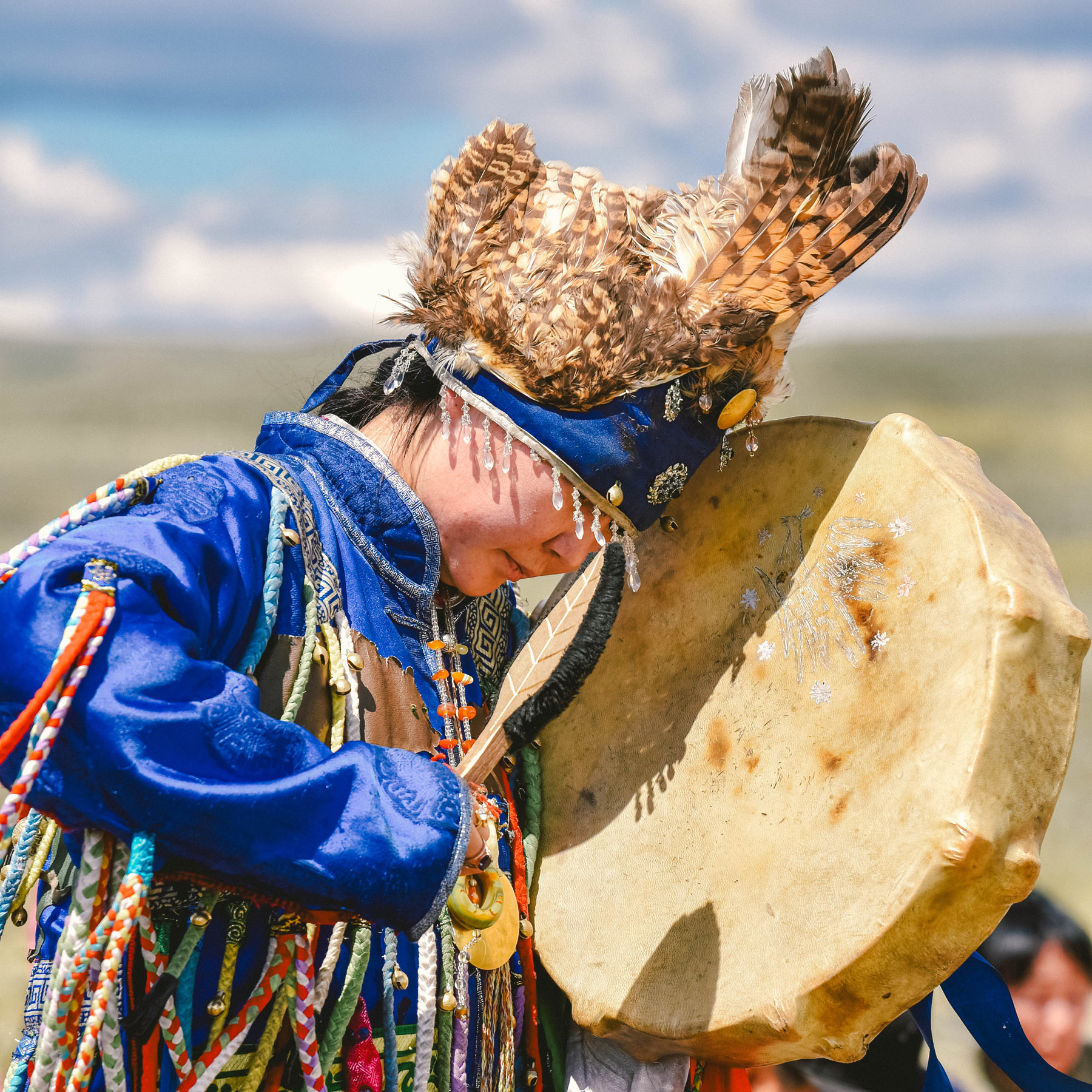
Someone brings them split wood. Two of them stack stones to form a fire pit. The third takes a small bowl, dips her fingers into it and splashes milk into the air – forwards, to the side, once more. Michail leans towards me. “For the spirits. They are announcing their arrival.”
We walk around the circle, but differently than before. More consciously. Every step suddenly seems to carry weight.
Holger whispers: “They’re probably waiting.” I wonder: For what? At that moment, one of the shamans lights the fire. With the first wisp of smoke, the atmosphere changes. It’s not a clear moment, more of a gentle sensation.
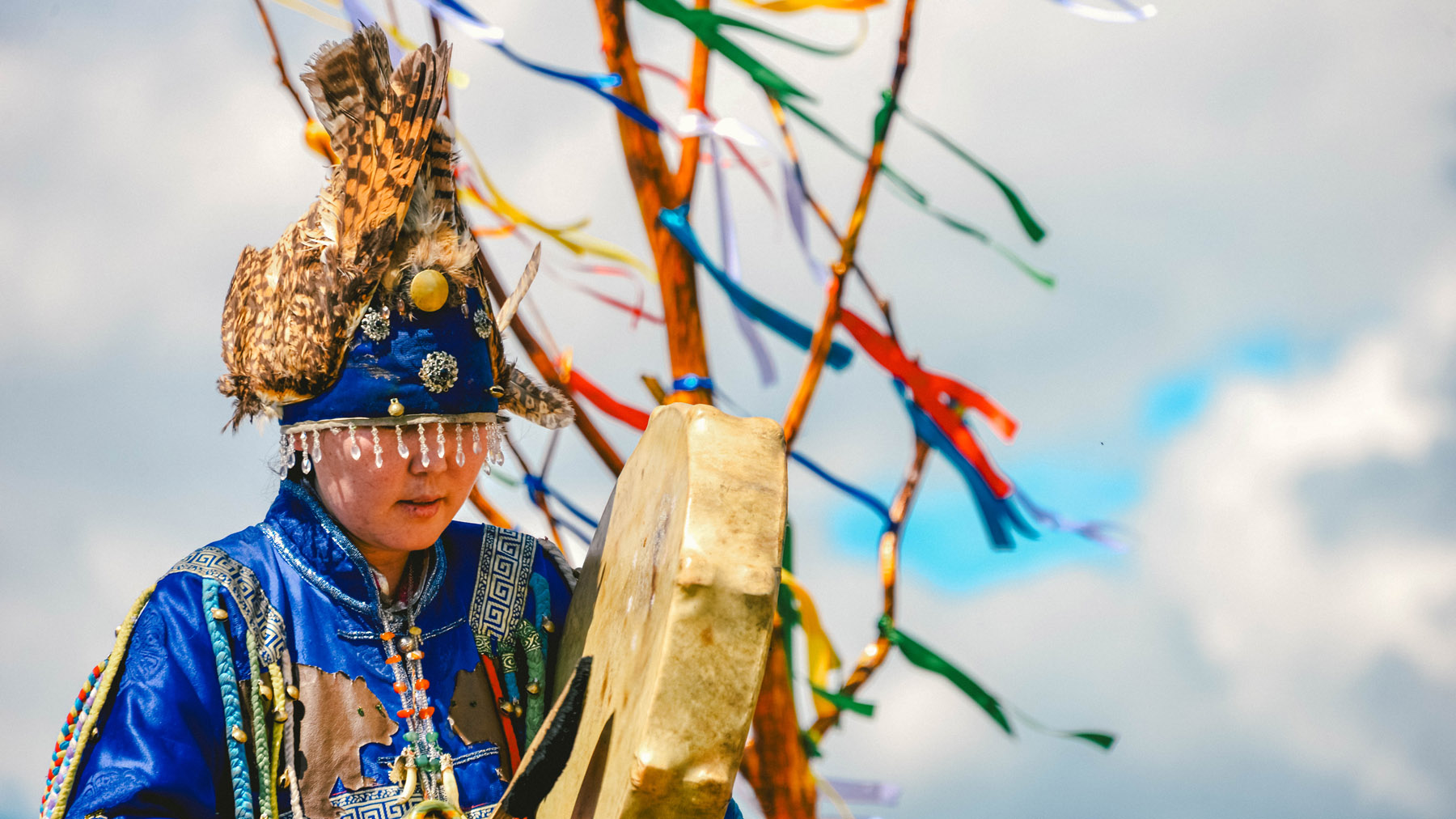
The shamans step in front of the fire. The first raises her drum, beating it slowly, evenly. Dull. Like a heartbeat. The second joins in, the third follows. A rhythm emerges that immediately settles into the body. Then they begin to sing. The voices are rough, deep, laced with sounds I do not understand – and yet they seem purposeful, as if addressing someone directly. Mikhail whispers: “They are calling the spirits. The ancestors. The guardians of this place.” The wind tugs at the ribbons of the ovoo, as if answering.
The shamans’ movements change. Standing gives way to a gentle swaying, and the swaying to a counter-clockwise circling. The drums grow faster, the voices more intense. One of the shamans tilts her head back, her eyes half-closed. Metal plates on her robe clink against one another as she turns.
Holger moves closer and takes photographs. Quickly, intently. I can see him trying to capture the moment, which is actually slipping away. “They’re already not quite here anymore,” says Michail. I feel goosebumps, even though the sun is warm.
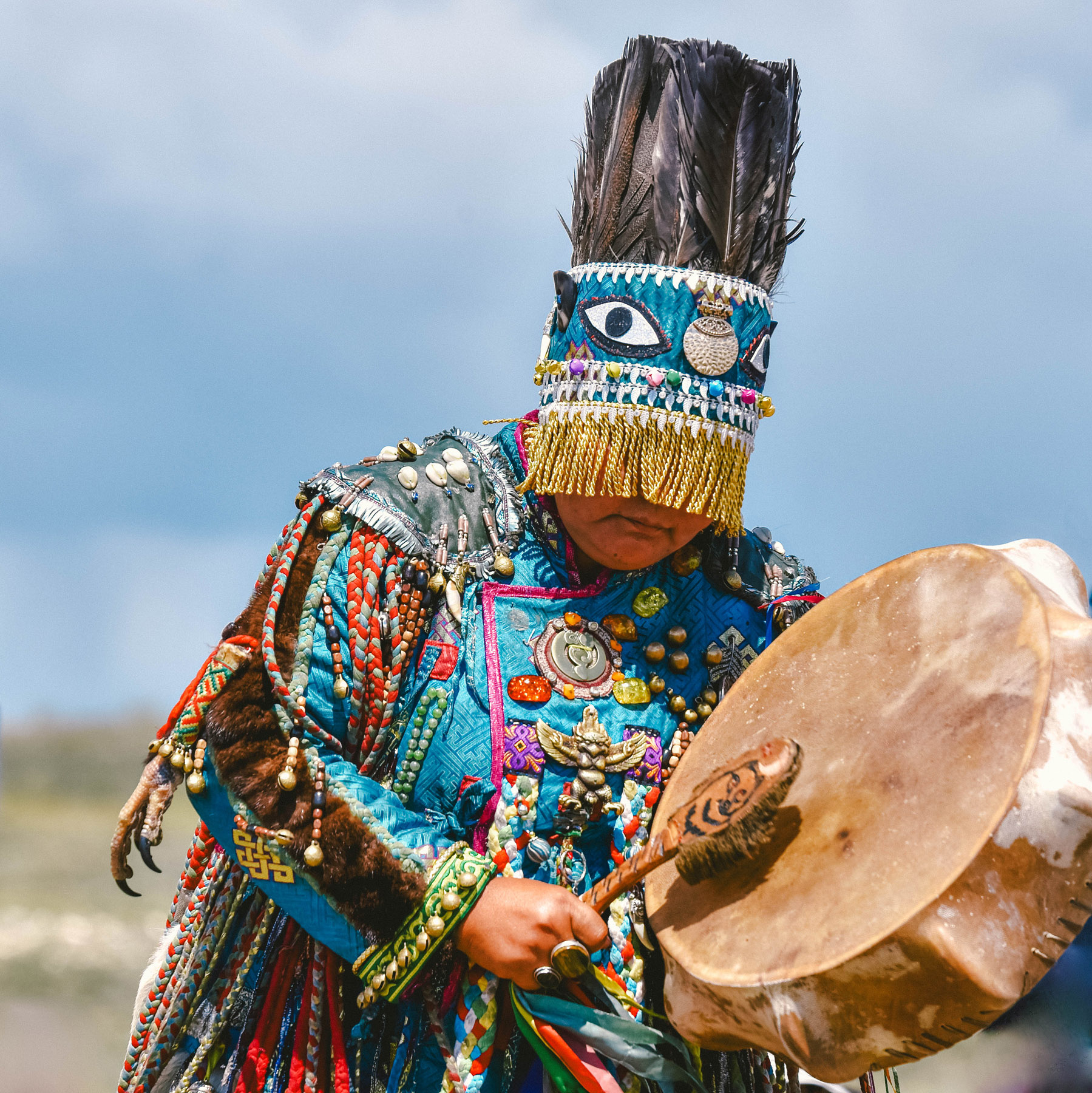
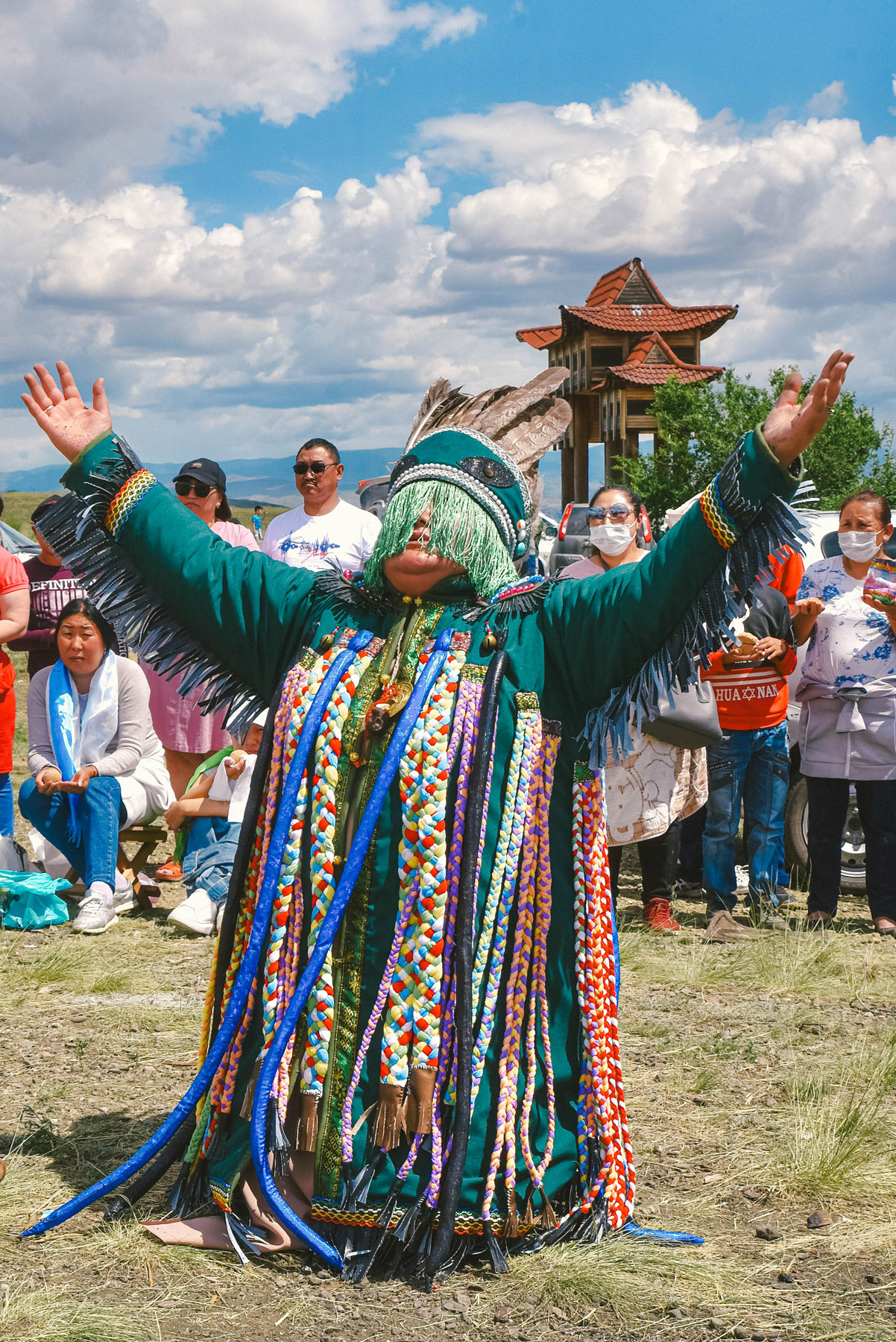
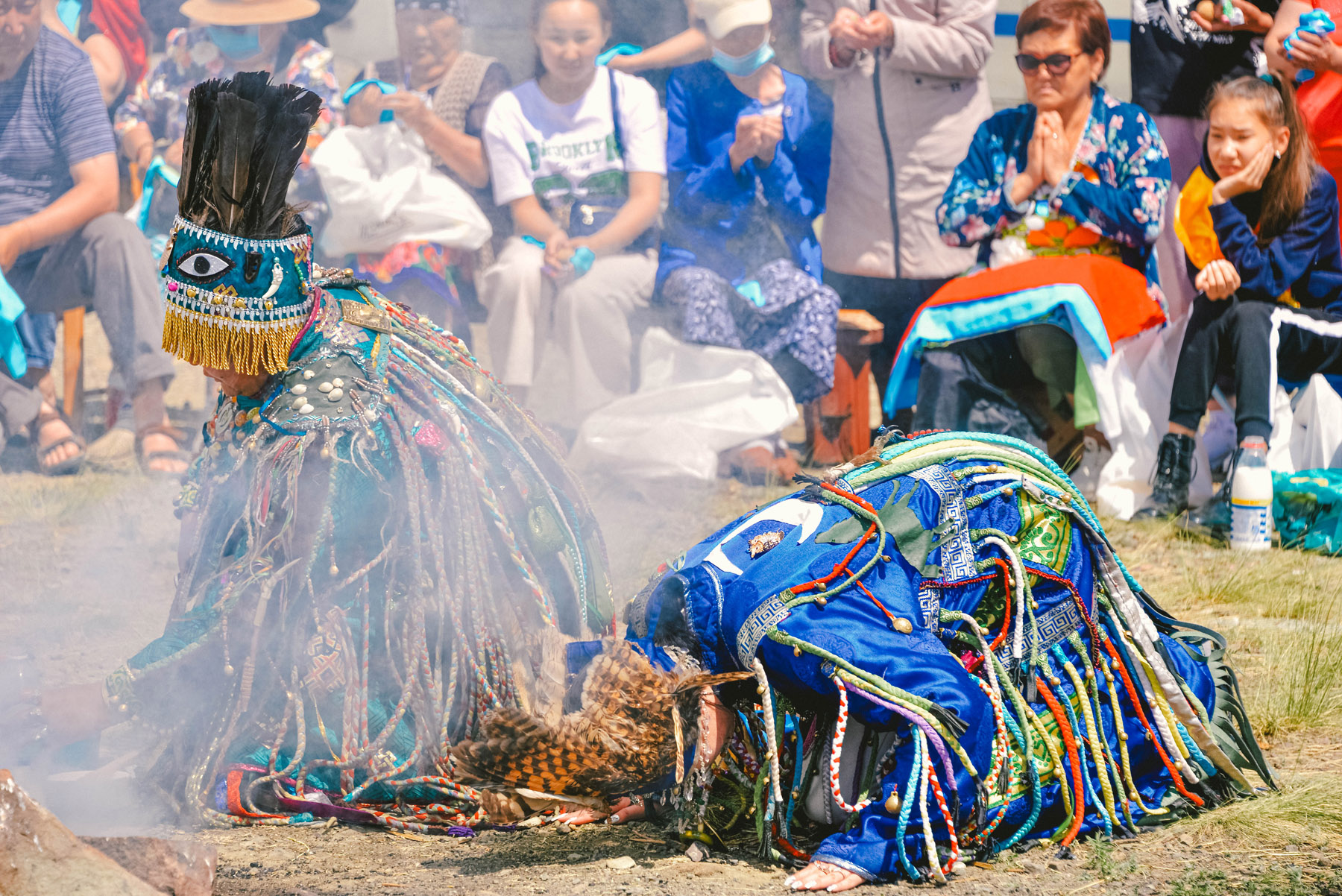
A shaman steps forward and pours milk and sour cream into the fire. It sizzles, the smoke thickens. Then she kneels down, raises her arms imploringly towards the sky and murmurs incomprehensible words. Another runs round the fire and throws grains of cereal into the air from a bowl. Everything happens calmly, without haste, but with a naturalness, as if every movement were both learnt and remembered. The shamans continue to move, now speaking faster, more urgently. It sounds like a dialogue – even if only one side can be heard. Mikhail: “They are asking for good fortune. For protection. For what people need.”
Most of the participants are seated; some are praying, others stand in reverence or are recording the ceremony on their mobile phones. One participant stands up and pours a sack of sweets she has brought with her over the fire. Suddenly, the rhythm changes. The drums slow down. A shaman swings burning juniper branches in front of her. Aromatic smoke rises. At the same time, she rings a small brass bell to the rhythm of the drums. Holger circles her, trying to capture it all. It seems to me that they don’t even notice him.
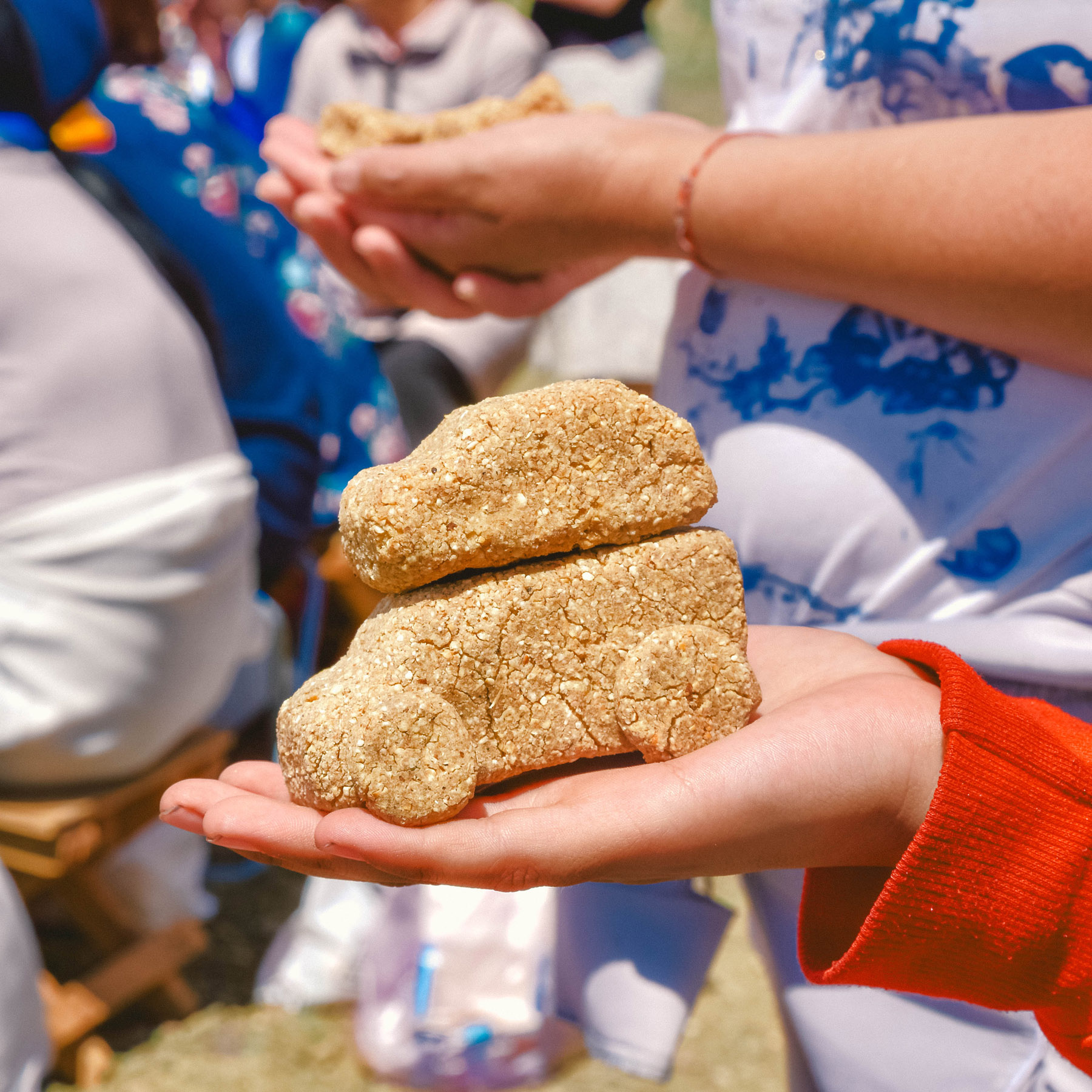
The shamans’ voices are now growing quieter. Their movements slow down. Finally, they stand still. This is the signal for two of the shamans’ assistants to distribute yellow and red khadags and handfuls of grain to the participants. On this occasion, I notice that many of them have kneaded a sort of tsampa dough from the coarse-grained barley flour they brought with them and the milk bottles lined up in front of them, and have shaped it into various forms. I spot several cars, a house and shapes I cannot clearly identify. I ask Mikhail, “Is that what they wish for?” He nods.
The Tailgan ceremony seems to be coming to an end, without any visible final climax. It is more as if the ritual were seeping away like water into the sand. The participants rise one by one, speak more loudly again, even laugh, and walk to the ovoo to tie their khadags around the branches and place their remaining sweets on the stones of the ovoo, touching the stones with their hands for a moment. When invited to do so, I follow their example, and on the way to the ovoo a woman presses a few sweets into my hand. As we walk back to the car, Michail says: “Now the ancestral spirits have heard the wishes and prayers. Whether they will help – we shall see.” Left behind are the hill, the ovoo and the fine smoke of the extinguished fire. And something that cannot be clearly named – but is there, and which we were privileged to witness.
SYLVIA FURRER, a Swiss lawyer/economist, and psychiatrist HOLGER HOFFMANN have traveled to over 100 countries since 1977. They became more and more fascinated by the customs and the daily life of indigenous peoples who preserve their traditional culture and subsist in remote areas under harsh conditions – from Siberia to the Danakil Desert, from the jungles of Western New Guinea to the Himalayas.
www.chaostours.ch